For years, contact centers have invested heavily in technology to improve the customer experience. Chatbots, self-service, knowledge management, and more recently, AI have all promised to reduce customer effort and improve operational efficiency.
But there is another side of the equation that deserves at least as much attention: the agent.
Customer service agents are expected to understand increasingly complex products, navigate multiple systems, and solve customer problems quickly, often while being measured against demanding KPIs such as Average Handling Time, First Contact Resolution and Customer Satisfaction.
Yet the way we prepare agents for this complexity is often surprisingly traditional; PowerPoint presentations. Static documentation. Knowledge bases. Classroom training.
The question I find increasingly interesting is simple: What if we gave agents the same interactive digital experiences we increasingly provide to customers?
From agent training to agent enablement
I believe we need to move beyond thinking about agent training as something that primarily happens before an agent starts taking calls.
The bigger opportunity is continuous agent enablement.
Technology can help agents learn faster, but it can also support them while they are actually solving customer problems.
Instead of reading instructions about how a product works, agents should be able to interact with it virtually. Instead of searching through lengthy documentation, they should be guided through troubleshooting processes step by step.
This is particularly relevant in industries such as Consumer Technology, Telecommunications, MedTech and FinTech, where products and services are becoming increasingly complex and change continuously.
The objective is ultimately straightforward: Reduce the time it takes for an agent to become proficient and give them better tools to resolve customer problems successfully.
A practical example: the Sony TV Simulator
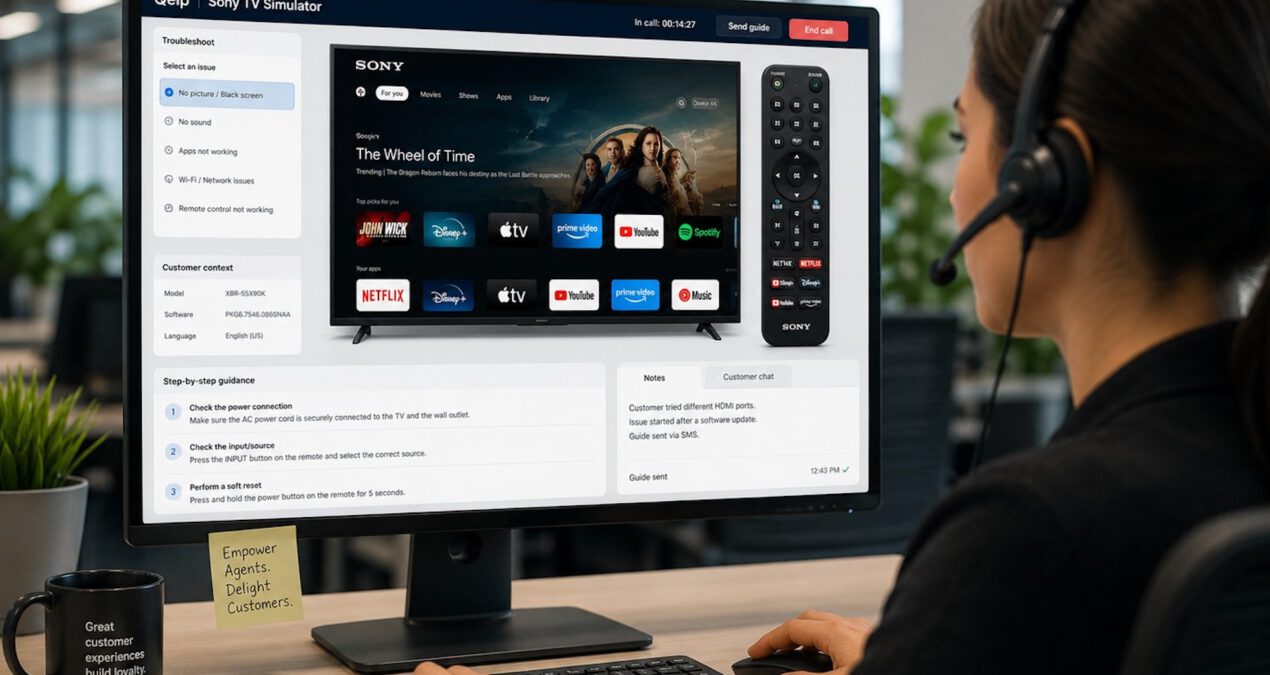
One example I have been closely involved with is a pilot using an interactive TV simulator in a Sony customer service environment in El Salvador. The concept is relatively simple.
Agents can virtually navigate a television interface and follow interactive troubleshooting flows without needing physical access to every device they support. During customer interactions, the simulator helps them understand what the customer is seeing and guides them through potential solutions.
But implementing technology is only the beginning.
We also interviewed agents to understand how they actually used the solution, where they encountered friction, and what could be improved. That feedback became an important part of continuously optimizing the experience.
The results were encouraging.
Comparing the 8 weeks before and after launch, First Contact Resolution increased from 75.0% to 75.4%, while Customer Satisfaction remained stable with a slight increase from 88.6% to 88.7%. Peak Average Handling Time decreased from 23.6 to 21.5 minutes, with AHT continuing to trend downward as agents gained more experience using the simulator. That’s a 2.1 minute win per call!
More interesting to me than any individual KPI was the pattern: performance continued to improve as agents became more proficient with the technology.
Technology alone is never the answer
One of my key learnings from working with digital customer service solutions is that simply implementing technology rarely solves the underlying problem. You need to understand the operation. You need to understand the customer journey. And, importantly, you need to understand the people who will actually use the technology.
That means talking to agents, observing how they work, analyzing operational data, and continuously improving the solution based on real world feedback.
The best technology should not make an agent’s job more complicated (and add more systems). It should remove complexity.
The next opportunity for customer experience
With AI now rapidly entering the contact center, I believe the connection between technology and people will become even more important. The conversation should therefore not only be about replacing customer contacts through automation (delicate subject). It should also be about asking: How can technology make the people handling the remaining, increasingly complex customer interactions significantly better at their jobs?
For me, that is where some of the most interesting opportunities in customer experience are emerging. And perhaps the future of the contact center is not about choosing between humans and technology.
It is about designing technology that helps humans perform at their best.